

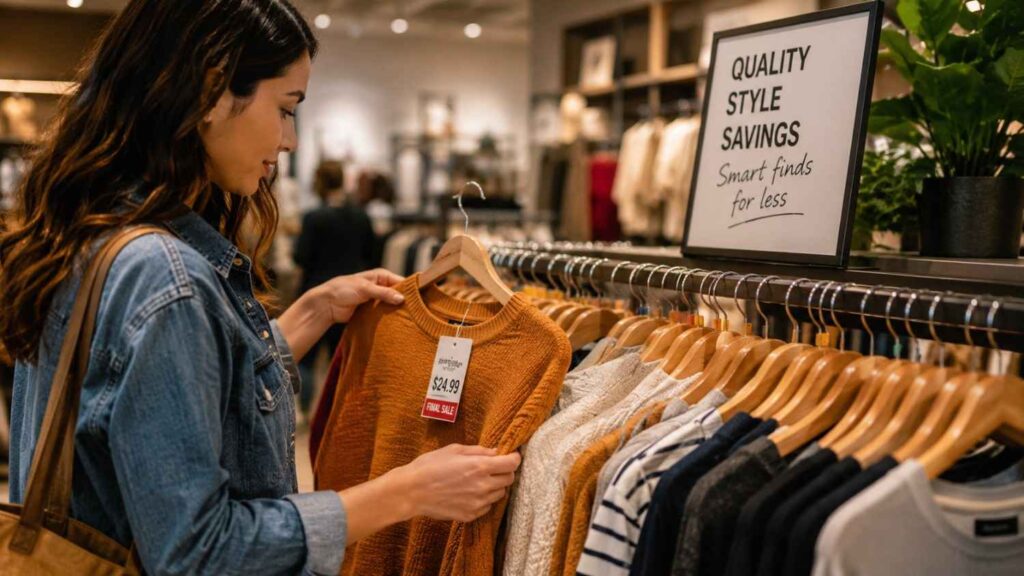
How to Find High-Quality Clothes at Discount Prices
Understanding how to find high-quality clothes at discount prices requires more than visiting clearance racks or waiting for seasonal promotions. The most successful bargain shoppers know how to evaluate fabric, construction, fit, condition, care requirements, and long-term usefulness before looking at the percentage reduction.
A garment can be inexpensive and still be poor value. If it loses its shape after several washes, feels uncomfortable, requires expensive maintenance, or does not coordinate with the rest of your wardrobe, the initial saving becomes less meaningful. In contrast, a well-constructed coat, pair of trousers, or everyday shirt can provide strong value when purchased during a genuine sale and worn repeatedly.
Price is also an imperfect measure of quality. High retail prices can reflect premium materials and skilled construction, but they can also include brand positioning, advertising, store overhead, and exclusivity. Likewise, lower-priced garments can sometimes offer durable fabrics, clean stitching, and practical design.
The objective is not to find the lowest possible price. It is to identify the best relationship between quality, usefulness, and total cost. This guide explains how to inspect garments, compare sales channels, shop safely online, evaluate outlets and secondhand clothing, and build a dependable wardrobe without automatically paying full retail prices.
What Makes a Piece of Clothing High Quality?
A high-quality garment performs its intended function well, maintains its appearance through reasonable use, and provides comfort without requiring constant adjustment. Quality cannot be judged by a single characteristic. Fabric, stitching, structure, hardware, fit, care requirements, and design all contribute to the final result.
Context is especially important. A lightweight running top should not be evaluated by the same standards as a wool overcoat. The running top may need moisture management, stretch, and fast drying, while the coat requires insulation, structure, durable lining, and secure closures. A fabric is not automatically poor because it is thin, synthetic, blended, or inexpensive. It becomes unsuitable when its characteristics do not support the garment’s purpose.
Good garment construction should also remain consistent across the whole item. A jacket may use attractive outer fabric but still perform badly if the lining pulls, the zipper catches, or the shoulder seams sit incorrectly. Similarly, a soft knit may feel luxurious in the store but develop excessive pilling if its surface is already weak.
Fit is equally important because even technically well-made clothing provides little value when it is uncomfortable or difficult to wear. The strongest purchases combine suitable materials, dependable construction, practical care, and a shape that works for the wearer. Learning to examine those elements together makes it much easier to recognize affordable quality clothing in any retail environment.
Fabric Should Match the Garment’s Purpose
The first question to ask about fabric is not whether it is natural or synthetic, but whether it is appropriate for the garment. Cotton, wool, linen, silk, polyester, nylon, elastane, and blended fabrics can all be useful when their performance matches the intended use. A durable travel shirt may benefit from a synthetic blend, while a winter sweater may need warmth, breathability, and resilience.
Examine the fabric’s weight, density, surface, recovery, and opacity. Fabric weight should feel appropriate for the design. A structured blazer usually needs enough substance to hold its shape, while a summer blouse may intentionally use lighter material. However, unexpected transparent patches or inconsistent thickness can signal weakness.
Surface condition is also revealing. Look for snagging, loose fibers, uneven texture, or early pilling. Gently compress and release the material to see whether it recovers. If appropriate, stretch a concealed section and observe whether it returns close to its original shape.
CottonWorks identifies factors such as shrinkage resistance, seam smoothness, color retention, and resistance to pilling as important aspects of textile performance. More information is available at:
https://cottonworks.com/learning-hub/quality-assurance/quality-testing/
Construction Should Look Clean and Secure
Garment construction refers to the way fabric pieces, linings, closures, hems, and supporting elements are assembled. Strong construction does not always involve decorative stitching or complicated tailoring. In many cases, the best signs are consistency, stability, and clean finishing.
Begin with the seams. They should lie relatively flat and follow the intended shape of the garment without severe puckering. Stitch length should appear consistent, particularly in high-stress areas such as armholes, pockets, waistbands, crotch seams, and zipper openings. Repeated skipped stitches or unraveling thread can weaken the garment quickly.
Check hems for even depth and secure stitching. Inspect buttonholes to see whether the edges are neatly finished rather than frayed. Buttons should sit firmly, and zippers should move without catching the surrounding fabric. On lined garments, the lining should provide enough room for movement without pulling or hanging below the outer layer.
Pattern alignment can offer another clue. Stripes, checks, and large prints that meet cleanly at visible seams often indicate careful cutting, although alignment is not essential on every low-cost garment. The overall goal is to identify thoughtful assembly rather than perfection. Consistent construction usually supports better wear, easier care, and a longer useful life.
Fit and Function Matter as Much as Materials
High-quality materials cannot compensate for a garment that fits poorly or fails to perform its intended function. Fit should be evaluated while standing and moving because clothing behaves differently once the body bends, reaches, sits, or walks. A garment that looks acceptable in a mirror may still pull across the shoulders, twist at the seams, or restrict normal movement.
When trying on a top or jacket, raise both arms and reach forward. The garment should move with you without exposing excessive areas or placing severe tension on the seams. For trousers and skirts, sit down, walk, and bend slightly. Check whether the waistband remains comfortable and whether the fabric pulls across the hips, knees, or seat.
Functional details should also work in practice. Pockets should be deep enough for their intended use. Zippers should open smoothly, buttons should remain closed, and hoods or collars should sit correctly. A coat should allow room for the layers you normally wear beneath it.
Fit does not always mean a garment must be perfect without alteration. Simple adjustments can improve value, but the underlying structure should be appropriate. Major shoulder, rise, or proportion problems are usually difficult and expensive to correct. A practical garment is one that supports comfort, movement, and repeated use.
Related Articles
How to Inspect Clothes Before You Buy Them
A reliable inspection routine allows you to compare garments consistently instead of being influenced by brand reputation, store presentation, or promotional pricing. The process does not need to take a long time. Once it becomes familiar, most garments can be evaluated in several focused minutes.
Start with the overall appearance. Look at the garment from the front, back, and sides. Check whether it hangs evenly, whether the seams appear balanced, and whether the shape matches the design. Then inspect the fabric under good lighting. Look for discoloration, stretched areas, surface damage, and inconsistencies that may be difficult to see on a crowded rack.
The next step is to examine construction. Turn the garment inside out and inspect seams, hems, linings, pockets, and closures. High-stress areas deserve special attention because they often reveal early weakness. For secondhand or clearance clothing, examine collars, cuffs, underarms, knees, elbows, waistbands, and seat areas for signs of wear.
Labels should be reviewed before the purchase is complete. Fiber content and care instructions affect comfort, durability, maintenance, and total ownership cost. A low purchase price may be less attractive when the item requires frequent professional cleaning or unusually delicate handling.
The following clothing quality checklist can help organize the process:
| Quality Check | Positive Signs | Warning Signs |
|---|---|---|
| Fabric | Even texture, suitable weight, good recovery | Thin patches, snagging, early pilling |
| Seams | Straight, smooth, secure stitching | Loose seams, skipped stitches, puckering |
| Hem | Flat, secure, and even | Twisting, rolling, or uneven length |
| Hardware | Smooth zipper and secure buttons | Sticking zipper, loose snaps, weak fasteners |
| Lining | Lies flat and allows movement | Pulling, bunching, or exposed raw edges |
| Condition | Clean, consistent color and stable shape | Stains, fading, odors, or stretched areas |
| Label | Clear fiber and care information | Missing, altered, or unreadable details |
Examine Seams, Hems and Hardware
Seams, hems, and hardware often reveal more about durability than the garment’s front-facing appearance. Retail displays naturally emphasize color, shape, and styling, while many construction weaknesses remain hidden inside the item. Turning the garment inside out allows you to assess how carefully it was assembled.
Focus first on areas that receive repeated tension. These include underarm seams, pocket openings, crotch seams, waistbands, shoulder seams, and the areas beside zippers. The stitching should be continuous and secure. Small thread tails may be harmless, but repeated loose loops, skipped stitches, or open seam sections can indicate poor quality control.
Examine the hem to confirm that it lies flat and follows the garment evenly. Twisted side seams or uneven hems may become more noticeable after washing. On trousers, check whether sufficient fabric remains inside the hem if future length adjustments might be needed.
Hardware should be tested rather than viewed. Open and close every zipper several times. Fasten buttons and snaps, and check whether they align correctly. Gently test button security without pulling aggressively. Metal pieces should not have sharp edges, corrosion, or loose attachments. Replacing one button may be simple, but several construction problems can make an otherwise attractive discount impractical.
Test the Fabric Carefully
Fabric testing should be gentle, respectful, and appropriate for the garment. The objective is not to damage the item but to identify visible weakness, instability, or existing wear. Begin by viewing the fabric under consistent light. This can reveal unexpected transparency, fading, stains, uneven dye, or worn areas that are difficult to notice in dim fitting rooms.
Rub a concealed section lightly between your fingers. A small amount of surface change may be normal, especially with brushed or textured fabrics, but immediate fuzzing can suggest a greater risk of pilling. Look closely at high-friction zones such as underarms, inner thighs, cuffs, and side seams. On secondhand garments, these areas may show more wear than the rest of the item.
Gently stretch a small section and release it. Knits and stretch fabrics should return reasonably close to their previous shape. Material that remains distorted may sag during wear. Woven fabric should feel stable without excessive shifting between threads.
For patterned or printed garments, inspect the color and design across folds and seams. Cracking, flaking, or inconsistent color may worsen with laundering. No quick store test can guarantee long-term performance, but careful observation can significantly reduce the risk of purchasing weak, damaged, or unsuitable fabric.
Read the Fiber and Care Labels
Fiber and care labels provide essential information that cannot always be determined by touch. In the United States, many textile and wool products must identify fiber content, country of origin, and the manufacturer or another responsible business. Covered garments are also generally required to include care instructions. The Federal Trade Commission provides detailed consumer and business guidance at:
https://www.ftc.gov/news-events/topics/tools-consumers/apparel-labeling
Fiber content helps you anticipate how the garment may feel, stretch, breathe, insulate, wrinkle, or respond to repeated washing. However, percentages should not be interpreted without context. Two garments with similar fiber labels can perform differently because yarn quality, fabric structure, finishing, and construction also matter.
Care instructions affect the total cost of ownership. A discounted garment that requires professional cleaning after frequent use may become more expensive than a machine-washable alternative. Similarly, an item that must be dried flat may be inconvenient for a household with limited space.
Check whether the label is readable and securely attached, especially when buying secondhand or designer clothing. Missing labels do not automatically mean a garment is poor, but they make care and authentication more difficult. Before buying, consider whether you can follow the recommended maintenance without changing your normal routine or adding significant expense.
Where Can You Find Quality Clothes for Less?
The best places to buy quality clothes for less are not limited to one type of retailer. Strong opportunities may be found in mainline clearance departments, off-price stores, outlet locations, consignment shops, thrift stores, sample sales, resale platforms, and seasonal warehouse events. Each channel has different advantages and risks.
Mainline clearance sections can be especially useful because they may include the same products that were previously offered at regular price. Outlet stores can also provide value, but shoppers should understand that some merchandise may be produced specifically for the outlet channel. Secondhand sellers offer access to discontinued designs, older manufacturing standards, and premium materials, although condition must be evaluated carefully.
The most important principle is to assess the individual garment rather than assuming that a certain store type always provides better quality. A thrift shop may contain an exceptionally well-made coat beside several heavily worn items. An outlet may carry a genuine past-season product beside a made-for-outlet version. A department-store clearance rack may include excellent basics as well as garments marked down because they fit poorly or were frequently returned.
Before shopping, decide which categories you need and what quality indicators matter most for them. A leather jacket, wool sweater, pair of jeans, and white shirt require different inspection priorities. When you enter any discount channel with a clear list, measurements, preferred materials, and a realistic budget, it becomes easier to compare value rather than react to the volume of available merchandise.
Shop Mainline Clearance Sections First
Mainline clearance departments are often a practical starting point because the products may have originated in the retailer’s regular seasonal assortment. Items can be marked down for many reasons, including excess inventory, discontinued colors, limited size availability, seasonal transitions, packaging changes, or the arrival of a replacement collection. None of these reasons automatically indicates poor quality.
Whenever possible, search for the exact product name, model number, or stock-keeping code. Compare the clearance item with archived product descriptions, brand listings, or authorized retailer pages. This can help confirm the original materials, construction details, care requirements, and previous selling price.
Inspect clearance items carefully because they may have been tried on repeatedly, returned, or moved between stores. Check makeup marks around collars, stretched hanger areas, missing belts, damaged packaging, loose security-tag holes, and signs of alteration. Ask whether the normal return policy still applies, since some clearance items become final sale.
It is also helpful to distinguish a genuine reduction from routine promotional pricing. Some retailers frequently advertise products as discounted, meaning the apparent regular price may not reflect the price most customers typically pay. Compare the final amount with similar garments in the market. A true bargain should offer both acceptable quality and a competitive price, not merely a dramatic percentage printed on the tag.
Approach Outlet Stores with Realistic Expectations
Outlet stores can offer worthwhile products, but they should not be treated automatically as warehouses filled with regular retail merchandise at reduced prices. Some outlets sell past-season inventory, customer returns, overstock, or products with minor cosmetic differences. Others carry items manufactured specifically for outlet locations, sometimes with different fabrics, linings, hardware, or construction details.
Consumers’ Checkbook reported that many outlet and factory stores sell merchandise made specifically for those sales channels. The report explains why shoppers should avoid assuming that every outlet product is identical to a mainline version. The investigation is available at:
https://www.checkbook.org/national/outlet-stores-what-do-they-really-sell/
Made-for-outlet clothing is not necessarily poor quality. It may provide acceptable performance at its intended price. The key is to evaluate it as an independent product instead of calculating value from a mainline comparison that may not be accurate.
Useful outlet shopping tips include checking style numbers, fiber labels, lining, hardware, seam finishing, and brand-specific outlet markings. Search for the product online when possible. Ask store staff whether it came from the regular retail collection, although the physical inspection should remain your primary evidence.
Compare the outlet price with similar garments from competing retailers. A familiar logo and high reference price should not replace an objective assessment of material, construction, fit, and expected use.
Search Thrift and Consignment Stores Strategically
Thrift and consignment stores can be excellent sources of affordable quality clothing because resale prices are influenced by condition, local demand, brand recognition, and inventory turnover rather than manufacturing cost alone. Shoppers may find older garments with substantial fabrics, careful tailoring, or discontinued designs that are difficult to locate in current collections.
A focused strategy produces better results than browsing without a plan. Begin with specific wardrobe needs, such as a wool coat, work trousers, denim jacket, or formal dress. Learn the measurements of similar garments that already fit you, because secondhand sizing may differ significantly across brands and decades.
Inspect high-wear areas closely. Collars, cuffs, underarms, elbows, knees, inner thighs, waistbands, and the seat of trousers often reveal the garment’s true condition. Check for stains, odors, fading, fabric thinning, missing fasteners, moth damage, damaged elastic, and previous alterations. Some issues are easy to repair, while others can make the item uneconomical.
Goodwill recommends examining fabric, stitching, sturdy denim, lining, and brand labels when assessing thrifted garments. Its guidance is available at:
https://www.goodwill.org/blog/shop/back-to-cool-thrifting-back-to-school-style/
Before purchasing, add any cleaning, repair, or alteration costs to the price. Secondhand clothing offers the strongest value when its condition, fit, and total restoration expense remain reasonable.
How to Find High-Quality Clothes at Discount Prices During Sales
Sales can reduce the cost of well-made clothing, but they can also encourage unnecessary purchases. Retailers design promotions to create urgency, increase order size, and move inventory. Shoppers who enter a sale without a plan may focus on how much they appear to be saving rather than how much they are spending.
A useful sales strategy begins before the promotion. Review your wardrobe and identify genuine gaps. Record the colors, garment types, measurements, and materials that work for you. Set a maximum price for each category based on realistic market comparisons rather than a retailer’s claimed original price.
During the sale, evaluate every garment using the same standards you would apply at full price. Inspect fabric, stitching, fit, care requirements, and return conditions. Check whether the item is part of the brand’s regular collection, a lower-cost promotional line, or a product created specifically for discount distribution.
It is also important to calculate the final cost. Shipping, alterations, cleaning, repairs, and return fees can reduce or eliminate the apparent saving. A final-sale garment that does not fit may have no practical value even when it was inexpensive.
The most successful way to shop clothing sales is to treat the promotion as a timing opportunity rather than a reason to lower your standards. The sale should make a suitable garment more affordable. It should not make an unsuitable garment appear necessary.
Create a Shopping List Before the Sale
A detailed shopping list prevents sales from turning into unplanned wardrobe expansion. Begin by reviewing the clothes you wear regularly and identifying specific gaps. Instead of writing “tops,” list something more precise, such as “machine-washable white work shirt,” “midweight navy sweater,” or “short-sleeved casual top that matches black trousers.”
Include preferred measurements, colors, fabrics, care limitations, and maximum prices. This information reduces the influence of attractive displays and helps you compare products objectively. It also prevents duplication. Many shoppers purchase several versions of familiar items while continuing to overlook the categories they genuinely need.
Divide the list into priorities. Essential replacements should come first, followed by useful additions and optional items. A worn-out winter coat may deserve more attention than another discounted evening top. Estimate how frequently each item will be used and whether it coordinates with at least three existing outfits.
When a sale begins, search the list rather than the entire website or store. This saves time and reduces decision fatigue. It also makes it easier to walk away when the available products do not meet your requirements.
A shopping list does not eliminate flexibility. An unexpected item may still be worthwhile, but it should satisfy the same standards. The purpose of the list is to keep the discount connected to a real need rather than allowing the promotion to create one.
Establish a Real Price Baseline
A crossed-out price does not always show what shoppers normally pay. Some products are frequently discounted, while others may have been introduced with a high reference price before moving quickly into promotion. Establishing a realistic price baseline helps you determine whether the sale offers genuine value.
Search the exact product name, style number, or identifying description. Compare prices across the brand’s website, authorized retailers, off-price sellers, and reputable resale platforms. Make sure the products are truly comparable. Similar-looking garments may use different fabric blends, linings, hardware, or construction.
Review price history when reliable information is available, but do not assume every third-party tracker covers clothing accurately. A simpler approach is to observe the product over several weeks when the purchase is not urgent. Sign up for price alerts or retailer notifications only when you are comfortable receiving promotional messages.
Calculate the complete purchase cost. Include shipping, sales tax, alterations, professional cleaning, repairs, membership requirements, and return fees. A jacket discounted from $200 to $100 may not be the best choice if it needs $40 in alterations and cannot be returned.
Price comparison should remain connected to quality. A lower price on a weaker garment does not automatically represent better value. The strongest baseline compares products with similar materials, construction, function, and expected lifespan.
Evaluate Cost Per Wear
Cost per wear is a simple method for comparing the long-term value of clothing. Divide the total ownership cost by the number of times you realistically expect to wear the garment. Total ownership cost should include the purchase price as well as predictable alterations, repairs, cleaning, and maintenance.
For example, an $80 coat worn 80 times has a purchase cost of approximately $1 per wear before cleaning or repair expenses. A $20 novelty jacket worn only twice costs $10 per wear. Although the second item is cheaper at checkout, it provides less practical value.
The method is most useful when estimates remain realistic. Do not assume that an aspirational garment will be worn weekly if your lifestyle rarely requires it. Consider climate, dress codes, comfort, color coordination, care requirements, and the number of similar items you already own.
Cost per wear should not become the only decision factor. Special-occasion clothing may naturally have a higher figure, and emotional or cultural value can also matter. However, the calculation is helpful for everyday essentials such as coats, jeans, shoes, workwear, and knitwear.
When comparing quality clothes on a budget, cost per wear encourages you to prioritize durable, versatile garments instead of simply choosing the lowest ticket price. It turns the purchase decision from a short-term discount calculation into a longer-term assessment of usefulness.
How to Buy Discount Clothing Online Safely
Buying discounted clothing online provides access to a wider range of brands, sizes, resale listings, and seasonal reductions. It also removes several important advantages of in-person shopping. You cannot feel the fabric, inspect the seams closely, test the zipper, evaluate odors, or confirm the fit before paying.
For that reason, online shoppers should evaluate the seller and listing with the same care they apply to the garment. A professional website design does not guarantee that a retailer is reliable. Review independent feedback, contact details, payment methods, return conditions, and the clarity of product information.
Detailed listings should include fiber content, care instructions, multiple photographs, sizing information, and a clear description of condition. Resale listings should disclose stains, repairs, alterations, missing accessories, or other defects. When information is incomplete, ask questions before purchasing.
Payment protection also matters. Avoid being moved outside an established platform to complete a transaction. Use payment methods that provide a documented process for disputes when merchandise is not delivered or significantly differs from the listing.
Designer merchandise requires additional caution because extreme discounts may attract counterfeit sellers. Authentication services can reduce risk, but shoppers should still verify eligibility, coverage, and return conditions.
Online buying becomes safer when decisions are based on evidence rather than attractive photographs. Measurements, seller history, policy details, product identifiers, and secure payment procedures provide a more reliable foundation for evaluating discount clothing remotely.
Research the Seller and Return Policy
Seller research should begin before you enter payment information. Search the business name together with terms such as “reviews,” “complaints,” “returns,” or “scam.” Look for patterns rather than relying on one highly positive or negative comment. Repeated complaints about missing orders, incorrect merchandise, difficult refunds, or unauthorized charges deserve attention.
Confirm that the website provides working contact information and a clear physical or business identity. Read the shipping policy, expected delivery timeframe, return window, refund method, and any restocking or return-shipping fees. Determine whether discounted products are final sale and whether online purchases can be returned to a physical store.
The FTC advises online shoppers to understand the total price, retailer identity, and refund terms before completing a purchase, especially when dealing with an unfamiliar seller. Its consumer guidance is available at:
https://consumer.ftc.gov/consumer-alerts/2021/06/shopping-online-know-your-retailer-your-rights
Take screenshots or save copies of the product description, price, condition notes, and return policy. These records may be useful if the listing changes later.
A restrictive return policy does not always mean the seller is unreliable, but it increases your risk. When fit, color, or fabric quality remains uncertain, paying slightly more to a seller with clear returns may be financially safer than choosing a deeper discount with no practical remedy.
Request Measurements and Detailed Photographs
Clothing size labels are not standardized across brands, regions, product lines, or manufacturing periods. A garment marked “medium” may fit very differently from another item with the same label. For online purchases, actual garment measurements are more dependable than the stated size.
Ask for the measurements most relevant to the item. Shirts and jackets may require chest width, shoulder width, sleeve length, and total length. Trousers may require waist, rise, hip, thigh, inseam, and leg opening measurements. Compare them with a similar garment you already own rather than relying only on body measurements.
Detailed photographs should show more than the front and back. Request close views of the fiber label, care label, brand label, seams, hems, buttons, zipper, lining, and areas where wear commonly develops. For shoes or bags, ask for soles, corners, handles, hardware, and interior surfaces.
Lighting can affect color, so ask whether the seller believes the photographs represent the item accurately. For resale clothing, request images of stains, repairs, fading, or other disclosed damage.
Polite, specific questions benefit both parties. A seller who provides clear measurements and photographs helps reduce returns and disputes. If important information is repeatedly avoided, consider the uncertainty part of the purchase risk and be prepared to choose another listing.
Be Careful with Designer Bargains
Designer discounts require additional verification because high demand and recognizable branding create opportunities for counterfeit sellers. Extremely low prices do not prove that an item is fake, but they should prompt closer examination, particularly when the seller is unfamiliar or the product is widely counterfeited.
Begin by checking whether the retailer is authorized by the brand. For resale listings, review seller history, previous transactions, return terms, and the consistency of photographs. Compare logos, labels, stitching, hardware, materials, packaging, product codes, and construction with reliable reference information. Be cautious when sellers use stock images instead of photographs of the actual item.
The FTC warns that steeply discounted name-brand merchandise from unfamiliar sellers may be counterfeit. Its online-shopping guidance is available at:
https://consumer.ftc.gov/consumer-alerts/2021/06/shopping-online-know–your-retailer-your-rights
Some marketplaces offer authentication for eligible products. For example, qualifying eBay streetwear listings can display an Authenticity Guarantee checkmark and undergo inspection of materials, tags, logos, and construction. Current information is available at:
https://www.ebay.com/authenticity-guarantee/streetwear
Authentication programs have conditions and category limits. Confirm that the exact listing qualifies, understand how returns are handled, and avoid paying outside the platform. A convincing discount should never require you to abandon normal consumer protections.
How to Build a Quality Wardrobe on a Budget
Building a dependable wardrobe on a limited budget requires planning, patience, and a willingness to buy fewer items. The objective is not to own the largest possible collection of discounted clothing. It is to create a practical group of garments that fit well, coordinate easily, suit your lifestyle, and remain wearable over time.
Begin by examining what you already own. Identify the items you wear repeatedly and the reasons they work. They may have comfortable proportions, practical care instructions, useful pockets, versatile colors, or fabrics that perform well in your climate. This information is more valuable than following a generic list of wardrobe essentials.
Next, identify genuine gaps. A wardrobe can contain many clothes and still lack suitable options for work, changing weather, travel, or formal events. Prioritize garments that will solve recurring problems rather than adding more versions of rarely worn categories.
Budget allocation should reflect frequency of use and difficulty of replacement. Everyday coats, shoes, trousers, and workwear may justify more careful spending than highly specific trend items. However, higher spending should still be connected to better materials, construction, fit, or function.
Maintenance also affects wardrobe quality. Proper washing, storage, repair, and rotation can extend the usable life of both expensive and inexpensive garments. When shopping, choose items whose care requirements fit your routine.
A strong budget wardrobe develops gradually. Waiting for a suitable piece is usually more effective than buying an inadequate substitute simply because it is available at a low price.
Start with Frequently Worn Essentials
Frequently worn garments deserve the most careful evaluation because small differences in comfort and durability become significant through repeated use. These items may include coats, jeans, work trousers, knitwear, everyday shirts, shoes, and practical layers. The exact list should reflect your lifestyle rather than a universal wardrobe formula.
Review your normal week and note what you actually wear. Someone working in a formal office may prioritize tailored trousers and washable shirts, while a remote worker may gain more value from comfortable knitwear and durable casual clothing. Climate, transportation, social activities, and laundry access should all influence the list.
Choose colors and shapes that coordinate with several existing items. A garment becomes more useful when it can create multiple outfits without requiring additional purchases. Neutral colors can help, but they are not mandatory. A consistent personal palette is more important than following conventional rules.
Evaluate replacement difficulty as well. A specialized coat, well-fitting pair of trousers, or supportive shoe may deserve greater attention because finding another suitable version can take time. In contrast, basic accessories may be easier to replace.
Buying essentials does not mean selecting plain or uninteresting clothing. The goal is to combine personal style with repeated usefulness. When a discounted item fits well, performs reliably, and supports several outfits, it becomes a stronger foundation for the rest of the wardrobe.
Allow a Budget for Minor Alterations
Minor alterations can turn a discounted garment into a much better purchase, but their cost should be considered before checkout. Common adjustments include shortening sleeves or trousers, replacing buttons, slightly reducing a waistband, repairing a simple hem, or adjusting strap length. These changes may be affordable and predictable, depending on the garment and local tailoring prices.
Begin by identifying whether the fit problem is minor or structural. Length adjustments are often simpler than changes involving shoulders, armholes, trouser rise, jacket balance, or extensive resizing. A coat that is too large through the shoulders may require complicated work that costs more than the garment itself.
Inspect seam allowances and hem depth when alterations are anticipated. Extra fabric can make lengthening or releasing a garment possible, while narrow allowances may limit options. Patterned, lined, pleated, waterproof, or heavily embellished clothing may also be more expensive to alter.
Obtain a local estimate when the purchase depends on tailoring. Do not assume every adjustment is inexpensive. Add the estimated alteration cost, cleaning expense, and any replacement hardware to the purchase price before deciding.
Alterations are most valuable when the garment already has suitable fabric, sound construction, and a generally correct shape. Tailoring can refine a good purchase, but it cannot reliably transform weak materials or fundamentally unsuitable proportions into quality clothing.
Know When to Leave the Bargain Behind
Walking away is one of the most important skills in discount shopping. A garment is not a financial opportunity simply because the price is low. When the fabric is uncomfortable, the construction is weak, the fit is fundamentally wrong, or the care requirements are unrealistic, the discount does not solve the underlying problem.
Leave the item behind when damage is expensive or uncertain to repair. Persistent odors, widespread moth damage, severe fading, brittle elastic, peeling coatings, extensive pilling, and weakened fabric may be difficult to correct. Missing buttons or a loose hem can be manageable, but several defects together may indicate poor value.
Return restrictions should also influence the decision. A final-sale online garment with incomplete measurements places most of the risk on the buyer. If the seller will not provide information or clear photographs, uncertainty should be treated as a cost.
Consider how the item fits into your wardrobe. A dramatic piece may be attractive, but if it requires new shoes, accessories, undergarments, or outerwear, the real expense can grow quickly.
One question I recommend asking is, “Would I still want this without the sale sign or brand label?” If the answer is no, the purchase is probably being driven by promotion rather than need. Leaving an unsuitable bargain behind protects both your budget and wardrobe space.
Quick Answer About How to Find High-Quality Clothes at Discount Prices
Learning how to find high-quality clothes at discount prices begins with separating the value of the garment from the appeal of the promotion. A large percentage reduction may look impressive, but it tells you very little about the fabric, construction, fit, durability, or usefulness of the item. The quickest way to make a better decision is to inspect the garment as though it were being sold without a discount.
Start by reading the fiber and care labels. Examine the seams, hems, buttons, zippers, lining, and areas that experience regular stress. The fabric should have an even texture, appropriate weight, and reasonable shape recovery when it is gently stretched. The garment should also fit comfortably and work with pieces you already own.
Next, compare the sale price with the cost of similar products rather than relying entirely on the retailer’s reference price. Include shipping, alterations, cleaning, and return fees when considering the final expense.
Most importantly, ask whether you would still want the item if it were not marked down. That question helps distinguish a genuine wardrobe need from an impulse created by a sale sign. A worthwhile bargain is a well-made, useful garment purchased for less than its realistic market value—not simply the cheapest item available.
The Fastest Quality Test
A fast quality assessment should cover the fabric, construction, hardware, fit, and care requirements. Begin by holding the fabric in your hands. It should feel suitable for the garment’s purpose, with no obvious thin patches, snags, distorted areas, or premature surface fuzz. Gently stretch a concealed section and release it. Material that remains badly distorted may lose its shape after normal wear.
Next, inspect the visible seams and turn the garment inside out. Look for straight stitching, secure thread ends, flat hems, and smooth seam allowances. Loose threads alone are not always a serious problem, but skipped stitches, unraveling seams, or repeated puckering can indicate weak construction. Open and close every zipper, fasten the buttons, and check whether snaps feel secure.
Finally, try the garment on and move naturally. Raise your arms, sit down, bend, and walk. Quality is not limited to materials; it also includes comfort and function. If the garment pulls, twists, restricts movement, or requires constant adjustment, the discount will not make it a practical purchase.
The Safest Buying Rule
The safest rule is to buy only when the garment meets your standards independently of its discount. Retail promotions create urgency by emphasizing limited stock, short timeframes, or large percentage reductions. These messages can encourage shoppers to focus on the possibility of missing a bargain rather than the actual usefulness of the item.
Before purchasing, confirm that the garment fills a real wardrobe need, coordinates with several existing pieces, and suits your normal routine. A delicate blouse that requires professional cleaning may not be practical for someone who needs easy-care workwear. Similarly, a heavily discounted formal jacket may offer little value if formal events are rare.
Return conditions should also affect the decision. A slightly smaller discount from a retailer with a clear return policy may be safer than a final-sale item that cannot be tried properly. For online orders, check whether return shipping or restocking fees apply.
One useful question is: “Would I buy this at a modest discount rather than an extreme one?” If the answer is no, the promotion may be doing more work than the product itself. Genuine value comes from quality, usefulness, and a fair total cost.
Frequently Asked Questions
Shoppers frequently ask whether price, brand, fiber content, retail channel, or country of manufacture can reliably predict clothing quality. None of these factors should be used alone. A familiar brand may produce several product tiers, while an unknown label may offer strong materials and construction. Natural fibers can perform beautifully, but they can also shrink, wrinkle, pill, or wear quickly when the fabric is poorly made.
The most dependable approach is to evaluate the individual garment. This includes examining the fabric surface, seam stability, hardware, fit, care instructions, condition, and expected frequency of use. The seller and return policy should also be reviewed, particularly when purchasing online or buying designer merchandise.
Questions about outlets and secondhand clothing are especially common because those channels can provide significant savings but require greater attention. Outlet merchandise may differ from regular retail products, and used clothing may need cleaning, repair, or alteration. Neither factor automatically makes the item unsuitable. The total value depends on quality, condition, and final cost.
The following answers address common People Also Ask-style questions in greater detail. They are designed to help beginners establish a dependable evaluation process while giving experienced shoppers a clearer framework for comparing construction, sales channels, and long-term value. These principles can be applied across different budgets, styles, retailers, and geographic markets.
How can I tell whether clothing is good quality?
Begin with the fabric. It should have an even surface, appropriate weight, stable shape, and no obvious weak patches. Gently stretch a concealed area when the material is designed to stretch, and check whether it recovers. Look for early pilling, snagging, fading, or distortion.
Turn the garment inside out and inspect the seams. Stitching should be consistent, secure, and reasonably straight. Pay special attention to armholes, pockets, waistbands, crotch seams, and zipper openings. Hems should lie flat, buttons should feel secure, and zippers should operate smoothly.
Read the fiber and care labels. They help you understand composition and maintenance, although fiber names alone do not prove quality. Consider whether the required care is practical for your routine.
Finally, try the garment on and move. Sit, walk, bend, and raise your arms. Good-quality clothing should support its intended use without pulling, twisting, or requiring constant adjustment. A useful assessment combines materials, construction, fit, care, and condition rather than relying on price or brand reputation.
Are expensive clothes always better quality?
Expensive clothing is not always better quality. A higher price may reflect premium fibers, specialized manufacturing, detailed tailoring, ethical production practices, limited quantities, or strong quality control. However, it can also include advertising costs, celebrity partnerships, store design, packaging, brand prestige, and exclusivity.
The best way to evaluate an expensive garment is to compare its physical characteristics with similarly priced and lower-priced alternatives. Examine the fabric, seams, lining, pattern alignment, hardware, fit, and care instructions. Determine whether the item offers measurable improvements that matter to you.
A higher price may be reasonable for a well-structured coat, technical outdoor garment, or carefully fitted shoe because these products can require specialized materials and construction. It may be less meaningful for a simple item whose cost is largely connected to branding.
Lower-priced clothing can still provide value when the fabric is suitable, the construction is secure, and the garment fits well. The objective is not to avoid expensive products or assume cheap ones are equal. It is to understand what you are paying for. Quality should be demonstrated by performance, durability, and usefulness rather than inferred from the price tag alone.
Are outlet clothes lower quality than regular retail clothes?
Some outlet clothes are regular retail products that have been marked down because they are from a previous season, available in limited sizes, returned, or overstocked. Other garments are manufactured specifically for outlet stores and may use different fabrics, hardware, linings, details, or construction methods.
Made-for-outlet clothing is not automatically poor quality. It is usually designed to meet a lower price point and should be judged according to its own materials and performance. The problem occurs when shoppers assume it is identical to a mainline product and calculate the saving from a comparison that may not be valid.
Check style numbers, fiber labels, care labels, stitching, hardware, lining, and product descriptions. Search the exact item online when possible. Compare it with similar garments from other retailers rather than focusing only on the outlet’s reference price.
Consumers’ Checkbook has reported that many outlet stores sell products created specifically for those locations. Its outlet-shopping investigation is available at:
https://www.checkbook.org/national/outlet-stores–what-do-they-really-sell/
The safest approach is to treat every outlet item as an individual product. Buy it when the quality and final price are competitive, not merely because it carries a familiar label.
What fabrics should I look for when buying durable clothes?
There is no single fabric that is most durable for every type of clothing. Durability depends on fiber properties, yarn quality, fabric construction, weight, finishing, garment design, care, and how the item will be used. A fabric suitable for work trousers may be uncomfortable in a summer shirt, while a technical synthetic may outperform a natural fiber in activewear.
Look for material with an appropriate density and weight. Examine the surface for weak areas, snagging, loose fibers, or early pilling. For stretch garments, test whether the fabric returns to its original shape. For woven clothing, check that the threads appear stable and do not shift excessively.
Blended fabrics can offer useful combinations of comfort, resilience, stretch, or wrinkle resistance. Natural fibers such as cotton, linen, wool, and silk can also perform well, but their quality varies substantially.
Care practices influence durability. Even a strong fabric can shrink, fade, or lose shape when washed incorrectly. Read the care label and decide whether you can follow it consistently. Rather than shopping for one preferred fiber, evaluate whether the material’s construction and performance match the garment’s purpose.
Is buying secondhand clothing worth it?
Secondhand clothing can be worthwhile because it often provides access to better materials, established brands, discontinued styles, and distinctive garments at lower prices. However, value depends on condition, fit, cleaning requirements, repair needs, and the final amount paid.
Inspect the garment carefully. Check collars, cuffs, underarms, elbows, knees, inner thighs, waistbands, and seat areas for wear. Look for stains, fading, odors, moth damage, weakened elastic, damaged closures, previous repairs, and alterations. Some flaws are simple to correct, while others may continue to worsen.
Compare measurements with a garment you already own because older or international sizing may differ from current standards. For online resale purchases, request detailed photographs and confirm the return policy.
Add cleaning, alterations, and repairs to the purchase price. A $15 coat that needs $80 of restoration may not be a better value than a clean $60 alternative.
Secondhand clothing is most rewarding when you shop with a specific list and remain patient. The strongest purchases are garments with sound fabric, stable construction, useful design, and manageable maintenance—not simply items with recognizable brand labels.
How do I avoid counterfeit discount designer clothes?
Begin by buying from authorized retailers, established consignment businesses, or resale platforms with documented authentication and buyer-protection procedures. Verify that the exact product or category qualifies for any advertised authentication service. Do not assume the entire marketplace is covered.
Review the seller’s history, photographs, descriptions, return terms, and previous transaction feedback. Compare labels, logos, materials, stitching, hardware, serial information, product codes, and packaging with reliable examples. Be cautious when a seller uses only stock photographs or refuses to provide images of identifying details.
Extreme discounts can be a warning sign, particularly when the seller is unfamiliar or the item is in high demand. The FTC advises consumers to be cautious about dramatically discounted name-brand products because counterfeit goods may be offered through unfamiliar online stores.
Avoid payment methods that remove platform protections. Do not agree to complete the transaction through private messages, bank transfers, gift cards, or other arrangements that make disputes more difficult.
Even experienced shoppers may not be able to authenticate every item from photographs. When the purchase is expensive, professional verification or a platform-backed authentication process can be worth the additional cost. A genuine bargain should not require you to ignore obvious risk signals.
Conclusion
Learning how to find high-quality clothes at discount prices is ultimately a process of making evidence-based purchasing decisions. The percentage reduction is only one part of the evaluation. Fabric quality, seam construction, hardware, fit, care requirements, condition, seller reliability, and expected use all contribute to the garment’s real value.
A practical inspection routine can be used in almost any shopping environment. Begin with the fabric, turn the garment inside out, examine high-stress seams, test the closures, read the labels, and move while trying it on. For online purchases, replace physical inspection with detailed measurements, close photographs, seller research, and a careful review of the return policy.
Shopping channels should also be evaluated realistically. Mainline clearance sections may contain regular retail products, while outlet stores can carry both overstock and specially manufactured merchandise. Thrift shops and resale platforms can offer excellent materials and older designs, but condition and restoration costs must be included in the decision.
The strongest wardrobe is not necessarily the most expensive or extensive. It is a collection of useful garments that fit comfortably, coordinate with each other, and remain wearable through repeated use. By focusing on quality and cost per wear rather than promotional urgency, shoppers can spend less without continually replacing unsuitable clothing.
The most valuable bargain is a garment you would have chosen for its quality and usefulness even without the discount.
Final Takeaway
The central lesson is simple: inspect first and calculate the discount second. A reduced price cannot improve weak fabric, poor fit, unreliable hardware, or inconvenient care requirements. Before buying, evaluate whether the garment is physically sound, comfortable, useful, and reasonably priced compared with similar products.
Use a consistent checklist. Examine the surface of the fabric, inspect the seams from the inside, test buttons and zippers, review the labels, and check the fit while moving. When buying online, request measurements and detailed photographs, research the seller, and understand the return policy.
Consider the complete cost rather than the ticket price alone. Alterations, cleaning, repairs, shipping, and return fees can substantially change the value of a purchase. Cost per wear can also help distinguish an inexpensive impulse item from a more durable garment that will be used regularly.
Most importantly, allow yourself to leave without buying anything. Successful discount shopping is not measured by the number of reduced items purchased. It is measured by how many of those items become dependable parts of your wardrobe. Careful selection creates more value than frequent bargain hunting.
Next Step
The most useful next step is to create a personal clothing-purchase guide before your next shopping trip. Begin by listing the garments you genuinely need. Record your preferred colors, practical care requirements, approximate measurements, acceptable fabrics, and maximum budget for each category.
Measure several garments that already fit well. Keep the measurements in your phone so you can compare them with online listings, vintage sizing, and unfamiliar brands. Note which fabrics and labels have performed well for you, as well as any that have repeatedly caused problems such as shrinkage, discomfort, or excessive pilling.
Create a short inspection checklist covering fabric, seams, hems, hardware, fit, condition, care, and returns. Use the same checklist regardless of whether you are shopping at a luxury outlet, clearance department, thrift store, or online resale platform.
Finally, establish a waiting rule for nonessential purchases. A pause of several hours or days can reduce the influence of promotional urgency. When the item still appears useful after the excitement of the sale has passed, you can evaluate it more objectively.
